



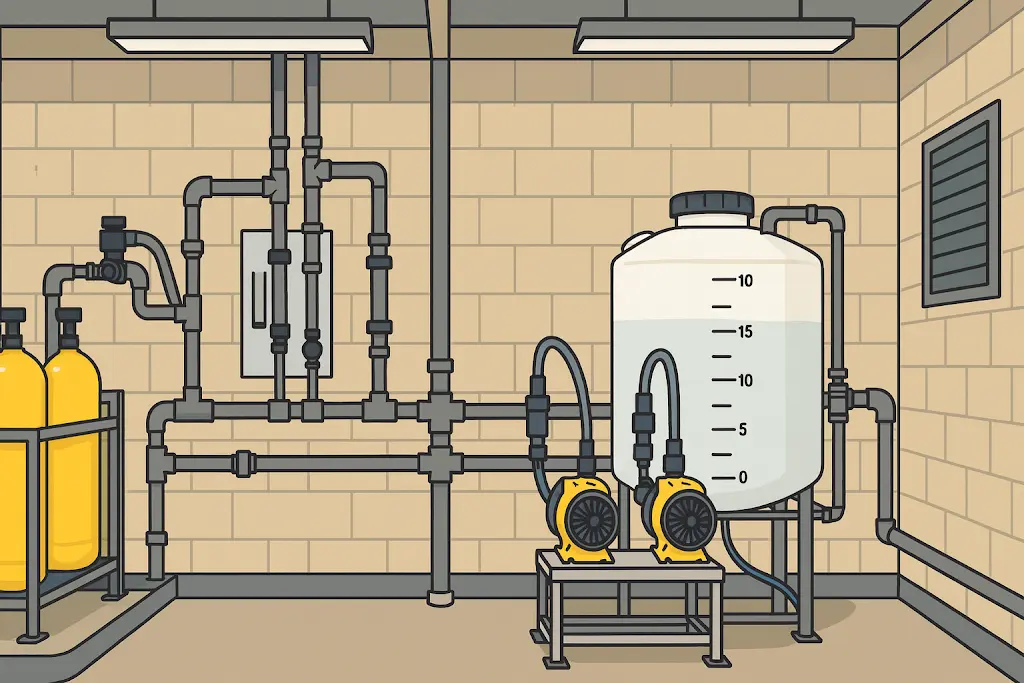
Choosing the right disinfection approach drives safety, compliance, and total cost of ownership in water treatment. This guide compares chlorine gas feed and liquid chemical feed at a practical level—how each works, where each shines, and what to consider for installation, control, and long-term OPEX.
When Each Option Makes the Most Sense
Choose chlorine gas feed (vacuum gas chlorination) when you want:
- Low lifecycle chemical cost at medium–large dose rates
- Consistent strength (no degradation like bulk hypochlorite)
- Compact footprint and sealed supply (cylinders/ton containers)
- Intrinsically safe vacuum operation and tight leak control
Start here: Gas Feed
Choose liquid chemical feed (e.g., sodium hypochlorite, calcium hypochlorite solutions) when you need:
- Simpler storage/permits in certain jurisdictions
- Multi-chemical flexibility (e.g., phosphate, ammonia, corrosion inhibitor, sulfur-based dechlor)
- Ease of feeding auxiliary chemicals through metering pump skids
- Smaller short-term capex or very low dose applications
Explore: Liquid Feed
How Chlorine Gas Feed Works
Vacuum gas chlorination pulls chlorine from cylinders through a vacuum regulator and ejector (injector), then into the water stream via a diffuser/nozzle. Because the system runs under vacuum, a line break draws air in instead of gas out—an inherent safety advantage for leak detection.
Typical train (high level):
- Cylinder/Ton Container → Vacuum regulator
- Rate control assembly → Ejector (injector)
- Check valve to prevent backflow → Diffuser in pipe or contact basin
- Feedback: Residual analyzer + control valve for closed-loop control
- Chemistry notes: Cl₂ hydrolyzes to HOCl + HCl; pH and alkalinity influence the HOCl/OCl⁻ ratio (and efficacy). Expect a slight pH drop; verify with on-line measurement.
- Materials: Use PVC/CPVC/PVDF and appropriate elastomers; avoid exposing stainless steel to wet chlorine service due to chloride stress corrosion.
- Pros: Lower chemical cost per lb of available chlorine; no storage degradation; small footprint; precise dosing with vacuum stability.
- Watch-outs: Cylinder handling, ventilation, and operator training; integrate alarms/interlocks and follow your industrial water treatment safety program.
Learn more: Gas Feed • Overview: Types of Chlorination Systems
How Liquid Chemical Feed Works
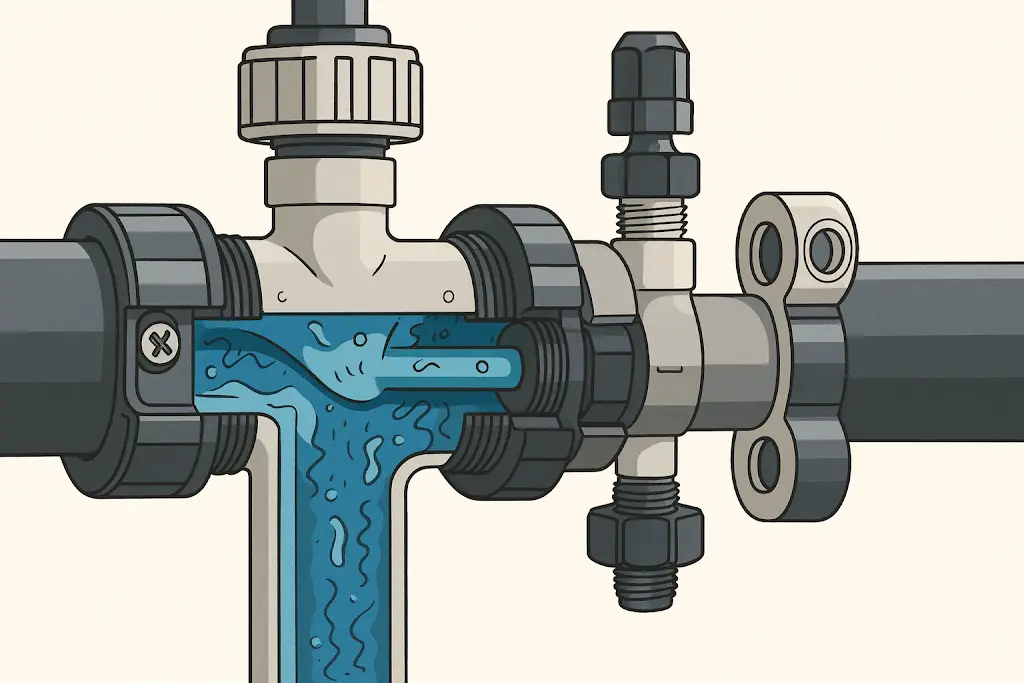
Liquid feed uses bulk or day storage tanks and chemical feed pumps (diaphragm, peristaltic pump, or plunger pump) to inject a chlorine-bearing solution into the process. Common oxidants include sodium hypochlorite (NaOCl) and calcium hypochlorite solutions; some plants also consider chlorine dioxide systems for special cases.
Typical train (high level):
- Bulk/day tank with secondary containment
- Suction strainer → Chemical metering pump (diaphragm or plunger)
- Pulsation dampener/anti-siphon → Injection quill/nozzle with check valve
- Residual control via analyzer + control systems (on/off, pace-with-flow, PID)
- Chemistry notes: Hypochlorite strength declines with heat, sunlight, metals (iron/copper), and time, raising required feed ratio; high pH can raise effluent pH and affect downstream filtration/flocculation.
- Materials: PVC/CPVC/PE/FRP are typical; be cautious with stainless steel wetted parts at high chloride.
- Pros: Straightforward permitting in many locales, flexible chemicals (you can also feed phosphate, ammonia, acids/alkali, sulfate/carbon dioxide for pH/alkalinity control).
- Watch-outs: Chemical viscosity/off-gassing, product decomposition (chlorate formation), drum/tank logistics, and frequent calibration.
Explore equipment: Liquid Feed • Vacuum-type liquid feeders: Conventional Vacuum Systems
Cost of Ownership: What Usually Drives the Numbers
- Chemical spend dominates OPEX: Chlorine gas typically carries a lower cost per lb of available chlorine than bulk hypochlorite. As flow and dose rise, the savings scale.
- Equipment/service: Gas systems often need less frequent chemical logistics; liquid systems can incur ongoing delivery and degradation losses.
- Energy & parts: Metering pumps (stroke/frequency) vs. gas ejector differential pressure—both are modest, but pump maintenance is a planning item.
- Compliance risk: Factor in alarms, ventilation, and containment—whichever path you choose.
For model families and parts, see the International Catalog (PDF):
Download Catalog
Control & Automation: Getting the Dose Right
Closed-loop control stabilizes residual and reduces waste:
- Analyze: A continuous residual chlorine analyzer pairs with your control strategy. See: Residual Analyzers
- Actuate: Gas—modulating control valve or rate controller; Liquid—pump speed/stroke (diaphragm), speed (peristaltic), or stroke (plunger).
- Strategies: Flow-paced feed, PID residual control, or feed-forward + trim.
- Good practice: Routine calibration, sample conditioning, and periodic grab-sample verification.
Water Chemistry & Process Considerations
- pH & alkalinity: HOCl is strongest in mildly acidic to neutral ranges; plan acid/alkali trim or carbon dioxide addition if needed.
- Temperature & heat exchanger effects: Affect reaction kinetics and hypochlorite decay; store chemicals cool and shaded.
- Demand: Ammonia, iron, sulfate/hydrogen sulfide, organics, and biofilm increase demand—pre-oxidation or upstream filtration may help.
- Materials: Choose polymers (polymer piping, PVC/CPVC, PVDF) for chloride service; specify stainless steel only where appropriate (e.g., frames, enclosures).
- Dechlorination: Sulfur compounds (e.g., sodium bisulfite) downstream of sensitive processes.
Sizing Snapshot (Rules of Thumb)
- Gas feed: Convert target dose (mg/L) × flow to lb/day Cl₂; size vacuum regulator and injector accordingly; confirm ejector differential pressure and backpressure limits.
- Liquid feed: Use solution strength to convert required lb/day to gph/L/h; pick feed pump capacity with 20–30% headroom and check viscosity/off-gassing; validate suction lift and NPSH for the pump type.
- Injection: Place the nozzle where turbulence and contact time are adequate; include a check valve and isolation valves for service.
See system families and selection tips:
Types of Chlorination Systems
Design the Right Chlorination Package with Hydro Instruments
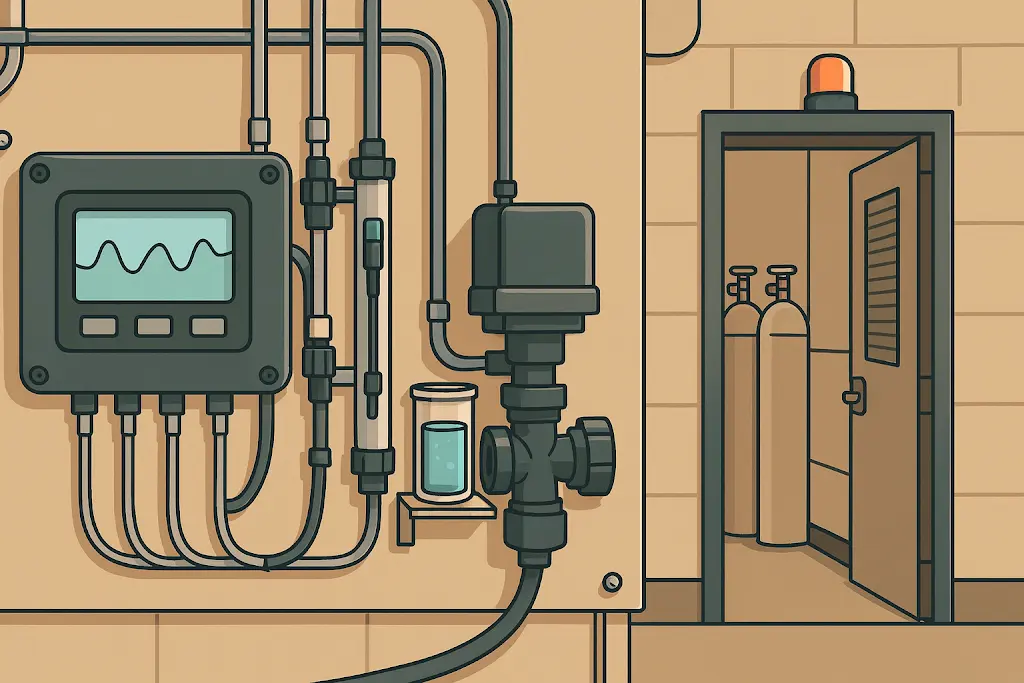
Not sure if gas feed or liquid feed is the better fit? Our applications engineers will size a safe, cost-efficient system around your flow, chemistry, and control goals—end to end.
FAQs
Is chlorine gas always cheaper than liquid hypochlorite?
At comparable dose rates, gas chlorine typically offers a lower delivered cost per lb of available chlorine. The bigger the plant flow and required ratio (mg/L), the more the savings matter. Still, confirm with your suppliers and local logistics.
Can I run closed-loop residual control with either option?
Yes. Both approaches work well with a residual analyzer and proper valving/pump control. Start here: Residual Analyzers
Which metering pump type should I choose for liquids?
Most applications use diaphragm pumps; peristaltic shines with off-gassing fluids; plunger pumps fit high-pressure duty. Match to chemical, viscosity, and required turndown.
Do vacuum systems exist for liquids too?
Yes—see Conventional Vacuum Systems for liquid-side vacuum feed approaches that add safety features similar to gas.
Ready to Compare Packages?
- Browse Gas Feed and Liquid Feed
- Review system options: Types of Chlorination Systems
- Specs and parts overview: International Catalog (PDF)
Comments are closed.